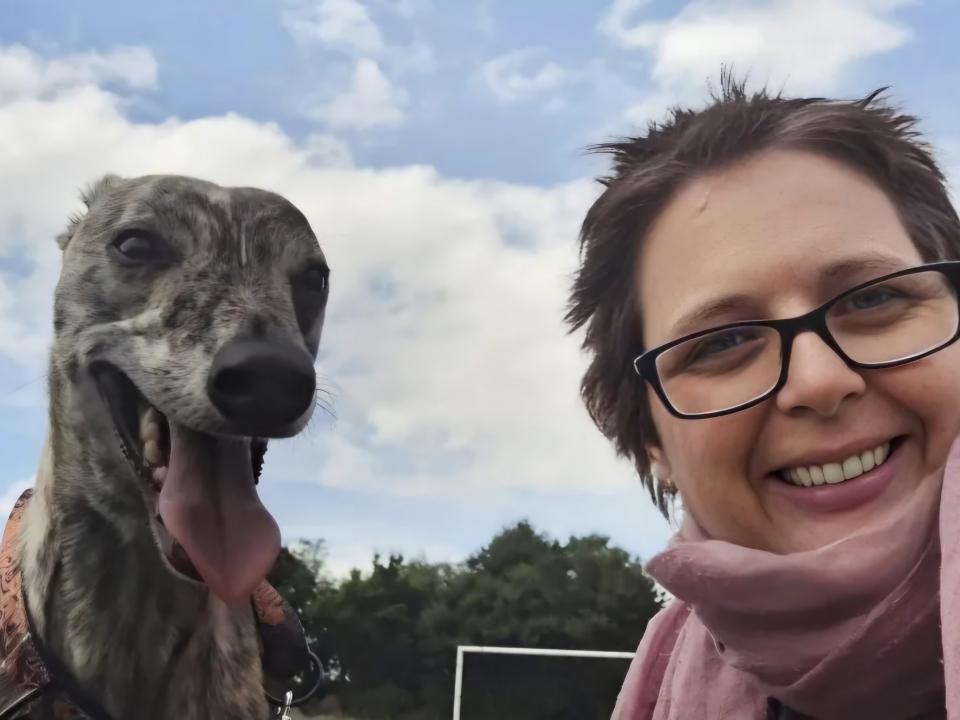
The pitter-patter of small paws around your home marks the beginning of a special bond with a new puppy, a relationship that is pure and unconditional. For those with disabilities, it can become more than just a dog/human connection – it can transform into a vital partnership.
When I became a dog mum to a whippet puppy four years ago, Oisín became more than just a pet. He was an astonishing ally, a best friend, an unofficial therapy dog, and somewhat of an MS guru, sensing changes when symptoms became more pronounced and when I needed to sleep. Sadly, he passed away unexpectedly 18 months ago due to severe epilepsy. The loss is still deeply felt, but I find comfort in Caoimhe, a boisterous beagle puppy born on Christmas Day, 2024.
Life with MS and raising an energetic pup by yourself is demanding, so lots of decisions need to be made before letting a four-legged thunderbolt into your life. The decision-making itself was a lesson in considering what my priorities should be, as well as being realistic in how far my neurological condition can allow any added upheaval and if my mental and emotional bandwidth would stretch wide enough should things go wrong.
After Oisín’s passing, I experienced a depression that, to this day, still lingers – the trauma of seeing a 3.5-year-old dog struggle to survive was more than I could handle. Needless to say, an increase in MS symptoms added even more helplessness to the myriad of emotional and neurological symptoms. But this experience also taught me to cherish the present moment, and once I was introduced to Caoimhe’s litter five months later, she instantly won my heart as she rushed out of her breeder’s crate, climbed right into my lap, and never left.
Despite difficult moments of quiet grief, she has given me a renewed purpose despite knowing that adding a lively pup to my family of one has and will at times interfere with my multiple sclerosis. Increased levels of already severe fatigue, chronic pain levels and piercing bouts of trigeminal neuralgia in and around my left eye is even playing out right now, but despite all the above, my focus is intently driven to loving and caring for Caoimhe, making symptoms less of a focused target. She acts as a calming presence, taking my mind off everything with her demand for hugs (read: food) and her slapstick antics. I consider her truly a four-legged mental and emotional health provider.
The choice to opt for a puppy rather than an adult dog was twofold: teaching her the same skills Oisín learned from a young age, and my emotional need to start over with a clean slate, a tabula rasa. He was taught to open doors, pick up things off the floor and even wake me up at a specific time to take medications – things I hope Caoimhe will eventually possess. As an 11-month-old pup, she is more driven by her incredible nose and problem-solving beagle skills rather than the emotional velcro-dog behaviour of whippets. At the same time, she is taking some time to apply her newfound knowledge permanently and as long as there are treats involved to justify her support for the MS cause, Caoimhe’s in.
Of course, not everyone with MS will find having a dog beneficial; there are days when furniture, clothes, shoes, and the garden suffer, and I’m not readily available to fill in the dug-up holes in the garden. Patience, as such, is essential for both our sanity.
With a mutual understanding of each other and a cupboard filled with treats and toys, even a boisterous, loudly snoring, food-obsessed pup, who turns your garden into an archaeological dig site, can make life with multiple sclerosis infinitely more rewarding.
You can read more on Willeke's blog Ireland, Multiple Sclerosis & Me
Add new comment