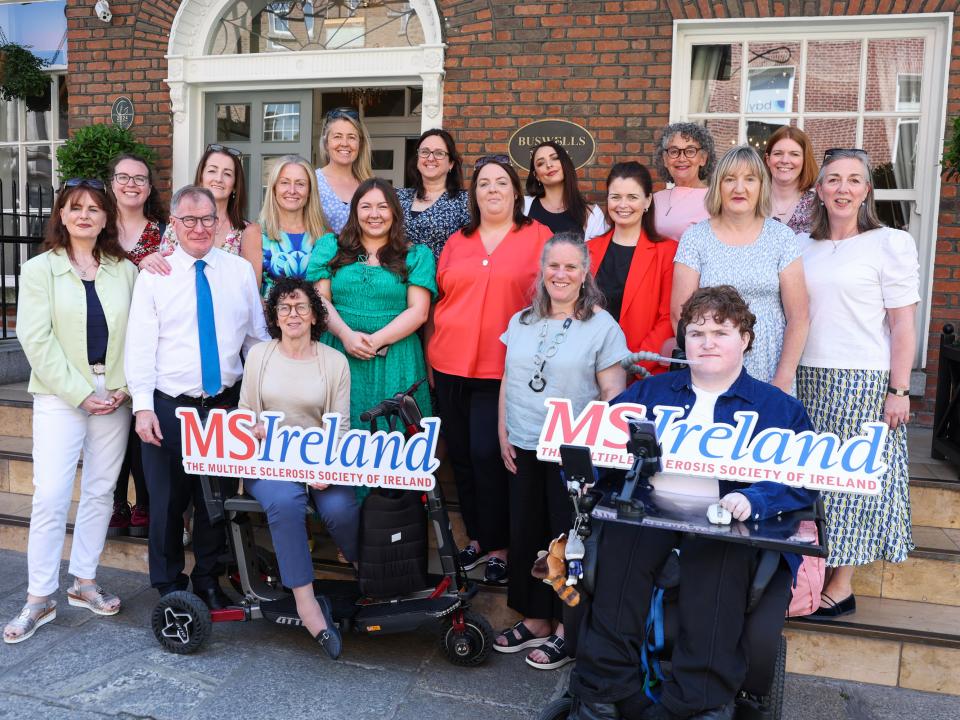
MS Ireland is seeking funding as part of a national €1 million investment in MS Ireland’s specialist neurological physiotherapy services, alongside an additional annual investment of €72,998 to fund a dedicated Community Worker post for Sligo-Leitrim.
At present, MS Ireland provides a Community Work service in every county in the Republic of Ireland except Sligo and Leitrim. The absence of a dedicated Community Worker leaves people living with MS in the region without structured, ongoing local support.
More than 300 people with MS are estimated to live in Sligo and Leitrim, with 122 already known to MS Ireland. Nationally, 2,538 people received one-to-one casework from MS Ireland in 2024, while new referrals increased by 26%.
MS Ireland is seeking annual funding of €221,076 in each of the Dublin and South East and the South West Regional Health Areas to directly employ four Senior Physiotherapists. This would support services across South-East Dublin, Carlow, Kilkenny, South Tipperary, Waterford, Wexford, Wicklow Cork and Kerry.
In the Dublin and South East Regional Health Area, approximately 3,558 people are living with multiple sclerosis, within a wider population of approximately 155,000 people living with neurological conditions. In the South West Regional Health Area, approximately 1,408 people are living with MS, within a wider population of approximately 118,500 people living with neurological conditions.
The proposed investment in physiotherapy services would support people living with multiple sclerosis and other neurological conditions, including Parkinson’s disease, stroke, brain injury, spinal injury and ataxia, helping them to stay active, independent and well in their own communities.
MS Ireland says investment in these services would help reduce pressure on primary care waiting lists and hospital services, while also providing an essential pathway for people leaving Community Neuro-Rehabilitation Teams.
The impact of MS Ireland physiotherapy services has already been significant, with reported reductions in healthcare service use of 43.1%, reduced A&E and inpatient service utilisation, a reduction in bed days, and improvements in quality of life, fatigue and mental health. Programmes have also helped reduce both the number of people falling and the number of falls experienced.
These services would be delivered on an individual and group basis, both online and in person, and would help address long waiting lists for primary care physiotherapy. MS Ireland has warned that many people living with neurological conditions are currently unable to access the ongoing rehabilitation support they need, creating a post-rehabilitation gap for people leaving the new Community Neuro-Rehabilitation Teams.
Without appropriate ongoing rehabilitation, people may experience increased falls, worsening mobility and fatigue, reduced independence and increased hospital utilisation.
Speaking at Leinster House, Dr Susan Coote, Physiotherapy & Exercise Coordinator, said:
“Our programmes, delivered by specialist neurological physiotherapists, have a very positive effect with many participants describing the expert education, tailored exercise and peer learning and social support that programmes bring as “life changing.
“For some people with MS, there is a sense that progression is inevitable, however we have shown with our programmes that we can maintain and in a lot of cases improve peoples’ ability to walk, to balance, and to take part in everyday activities. Our emphasis is on keeping people well at home through health promoting physical activity and through exercise for symptom management and this has been shown to be effective in preventing disability progression and in reducing symptom severity.
Speaking at Leinster House, Ava Battles, CEO of MS Ireland, said:
“People living with MS and other neurological conditions need timely access to specialist supports that help them manage symptoms, maintain mobility and remain independent in their own communities. Too often, people are left waiting for physiotherapy or are discharged from rehabilitation services without the ongoing support they need. This creates a real risk of people becoming less mobile, more isolated and more reliant on hospital services.”
Read the Full Pre-Budget 2027 Business Cases
Download the MS Ireland Pre-Budget 2027 Business Cases (PDF) to learn more about our proposals to expand specialist neurological physiotherapy services and establish a Community Worker in Sligo-Leitrim.